
I spent yesterday morning in the lower levels of Sector 4, where the synthesis hubs give way to workshops that do not advertise, looking for Cadence’s atelier, which currently commands what may be the most absurd waiting list in Neo-Milan. Two years at last count, and I am assured that money alone does not move you up it. The clientele are the ultra-wealthy in pursuit of the one thing they cannot print at home, since any household fabricator will produce a molecularly flawless evening jacket in roughly the time it takes to pour a drink, and perfection at that price has become, if I am being unkind, a little boring.
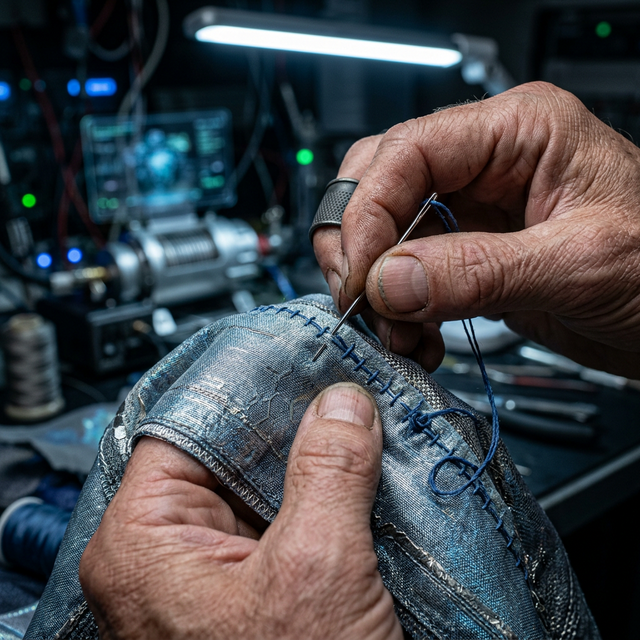
The mark of status has accordingly reversed itself, to the point where patrons now pay exorbitant fees for intentional human error. I watched a seamstress, master rank, work the hem of a silk-analog skirt entirely by hand and without visual assists, two apprentices observing her the way surgical students once watched theatre, before she misaligned it, quite deliberately, by a full centimeter. The stitching on the lapel was erratic in a way no fabricator would have tolerated. The client, a logistics executive, intends to wear the piece to the solstice ball, where half of Neo-Milan will eye the room through the society hosts, and where the crooked hem will quietly announce that she can afford something that survived the slow and inefficient process of human touch.
There is an irony here that I have not finished turning over. We spent the better part of a century engineering the human element out of the garment industry in pursuit of flawless precision, only to discover, having achieved it, that nobody much wants it. What people will now pay a fortune for is clothing that looks as though it survived an accident, provided the accident was made by hand.