
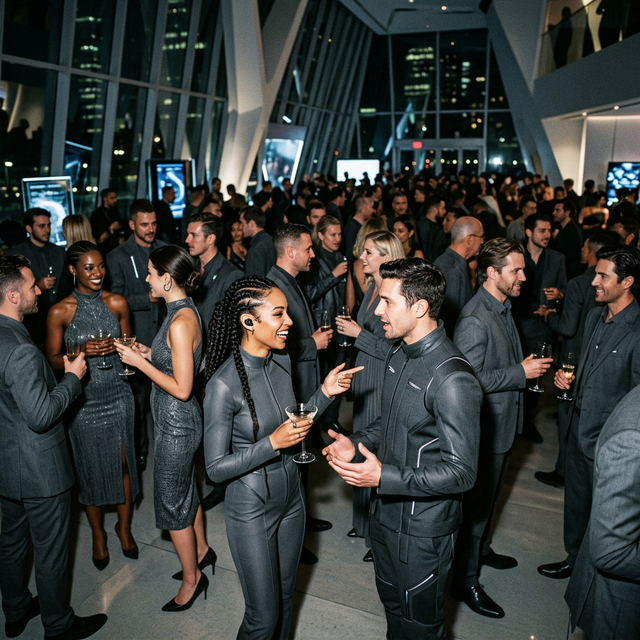
Walking through the Galleria Vittorio Emanuele II last night, I caught myself counting charcoal. The Gala for Applied Synthetics had just opened its memorial hour for the laborers lost in the orbital loom collapse, and within perhaps four seconds of the announcement every dress, suit and tunic in the hall had settled into the same muted grey, not because anyone chose it but because the poly-weaves read the room’s biometrics and performed the mourning on our behalf. A thousand guests stood dressed as a single synchronized choir without a single decision having been made among them.
This has become my standing quarrel with the standard weaves, which I have covered since their first runway. Clothing used to be our most immediate vocabulary, declaring intent or rebellion or solidarity before a word was spoken, whereas a weave that answers your biometric baselines perfectly says nothing at all. It amounts to an involuntary mood ring with a tailoring budget, and since human emotion turns out to be depressingly predictable in aggregate, it dresses us all alike at precisely the moments that used to reveal who we were.
We are left perfectly comfortable and perfectly camouflaged inside our own subconscious reactions, which may be why the most luxurious thing on offer this season is a garment that stubbornly stays the color you bought it, however sad you happen to feel. The journeymen’s waiting lists suggest the city has reached the same conclusion.